
The \(\pi\)-pad uses \(R_1\), \(R_2\) and \(R_3\) to match \(R_{IN}\) to \(R_L\). Circuit gain (\(A_{12}\)) is from input (1) to output (2). For example, if \(A_{12}\) is set to 0.25 then this is a 4:1 attenuation (-12.0412 dB).
|
Relevant Formulas |
$$R_X = \left[\dfrac{A_{12}^4 R_{IN}^2-2A_{12}^2 R_L R_{IN}+R_L^2}{4A_{12}(1-A_{12})\cdot (R_L-A_{12}R_{IN})}\right]$$ $$\hspace{1cm}R_{3A} = R_X\sqrt{1-\frac{R_{IN}}{R_X}}\hspace{5mm}R_{3B}=R_X\sqrt{1-\frac{R_{L}}{R_X}}\hspace{1cm}$$ |
| $$A_{12(MAX)} = \dfrac{1}{1+\sqrt{1-\dfrac{R_{IN}}{R_L}}}\hspace{1.8cm}R_L>R_{IN}$$ $$A_{12(MAX)} = 1-\sqrt{1-\frac{R_L}{R_{IN}}}\text{ }\hspace{1.8cm}R_{IN}>R_L$$ |
$$R_{3} = R_{3A}+R_{3B}$$ $$R_1 = \dfrac{R_XR_{IN}}{R_{3A}}\hspace{10mm}R_2 = \dfrac{R_XR_{L}}{R_{3B}}$$ |
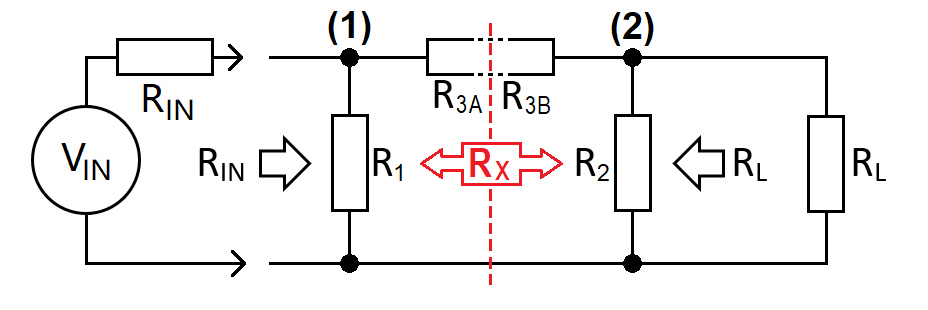
| \(R_{IN}\) | Ω | \(\boxed{R_1=}\) | Ω | ||
| \(R_L\) | Ω | \(\boxed{R_2=}\) | Ω | ||
| \(A_{12}\) | V/V | \(\boxed{R_3=}\) | Ω | ||
| \(A_{12}\text{ (dB)}\) | dB | \(\boxed{A_{12(MAX)}=}\) | V/V | ||
| Transfer values (applicable when analysing as two back-to-back L-Pads) | |||||
| \(\hspace{1cm} R_X\hspace{1cm}=\) | Ω | \(\hspace{1cm} R_3\hspace{1cm}=\) | Ω | ||
| \(\hspace{1cm} R_{3A}\hspace{0.9cm}=\) | Ω | \(\hspace{1cm} R_{3B}\hspace{0.8cm}=\) | Ω | ||
| \(\hspace{1cm} A_{1X}\hspace{0.9cm}=\) | V/V | \(\hspace{1cm} A_{X2}\hspace{0.8cm}=\) | V/V | ||
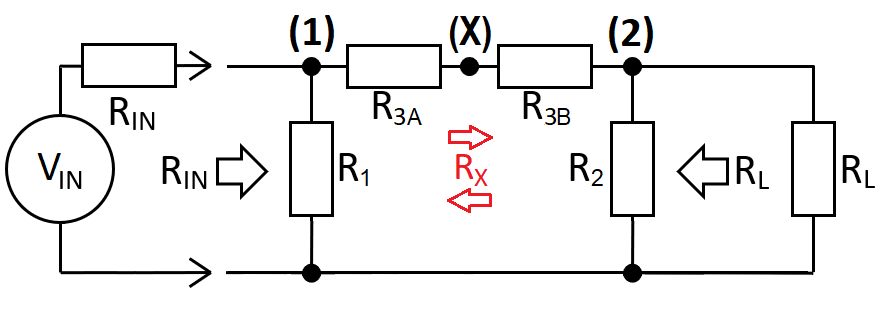
(1) Resistor \(R_3\) is split into two parts (a and b)
(2) Use formulas from the resistive matching L-pad
(3) Modify and apply to left and right sections.
$$R_{3A} = R_X \sqrt{1-\dfrac{R_{IN}}{R_X}}\tag{4}$$ $$R_1 = \dfrac{R_X \cdot R_{IN}}{R_{3A}}$$
$$R_{3B} = R_X \sqrt{1-\dfrac{R_L}{R_{X}}}\tag{5}$$ $$R_2 = \dfrac{R_{X}\cdot R_L}{R_{3B}}$$
Multiply the above attenuation formulas to get A12: -
$$A_{12}=\dfrac{R_X-R_{3B}}{R_X+R_{3A}}\tag{6}$$
Merging with equations (4) and (5): -
$$A_{12}=\dfrac{R_X-R_X \sqrt{1-\dfrac{R_L}{R_{X}}}}{R_X+R_X \sqrt{1-\dfrac{R_{IN}}{R_X}}}\hspace{1cm}=\hspace{1cm} \dfrac{1-\sqrt{1-\dfrac{R_L}{R_{X}}}}{1+\sqrt{1-\dfrac{R_{IN}}{R_X}}}$$
Focus on finding \(R_X\) in terms of required attenuation, input resistance and, output resistance
So, it's a case of laboriously resovling the two radicals: -
$$1-\dfrac{R_{IN}}{R_X} = \dfrac{\left[1-\sqrt{1-\dfrac{R_L}{R_{X}}}-A_{12}\right]^2}{A_{12}^2}$$ $$= \frac{1-\sqrt{1-\frac{R_L}{R_{X}}}-A_{12}-\sqrt{1-\frac{R_L}{R_{X}}} +1-\frac{R_L}{R_{X}}+A_{12}\sqrt{1-\frac{R_L}{R_{X}}}-A_{12}+A_{12}\sqrt{1-\frac{R_L}{R_{X}}}+A_{12}^2}{A_{12}^2}$$ $$1-\frac{R_{IN}}{R_X} = \frac{1}{A_{12}^2}\left[2-2A_{12}+A_{12}^2+(2A_{12}-2)\sqrt{1-\frac{R_L}{R_{X}}}-\frac{R_L}{R_X}\right]$$ $$\frac{A_{12}^2-\frac{A_{12}^2R_{IN}}{R_X}-A_{12}^2-2+2A_{12}+\frac{R_L}{R_X}}{2A_{12}-2}=\sqrt{1-\frac{R_L}{R_{X}}}$$ $$1-\frac{R_L}{R_X} = \left[\frac{\frac{R_L}{R_X}+2A_{12}-2-\frac{A_{12}^2R_{IN}}{R_X}}{2A_{12}-2}\right]^2$$
That's got rid of the radicals. Next, collect the expanded terms and manipulate: -
| Left hand side of formula | = | The sum of these terms |
| $$\left(1-\frac{R_L}{R_X}\right)\left(2A_{12}-2\right)^2\hspace{1cm} $$ | = |
\(\hspace{5mm}+\frac{R_L^2}{R_X^2}\hspace{7mm}+2\frac{A_{12}R_L}{R_X}\hspace{3mm}-2\frac{R_L}{R_X}\hspace{6mm}-\frac{A_{12}^2R_LR_{IN}}{R_X^2}\) \(\hspace{2mm}+2\frac{A_{12}R_L}{R_X}\hspace{3mm}+4A_{12}^2\hspace{6mm}-4A_{12}\hspace{6mm}-2\frac{A_{12}^3R_{IN}}{R_X}\) \(\hspace{4mm}-2\frac{R_L}{R_X}\hspace{5mm}-4A_{12}\hspace{7mm}+4\hspace{13mm}+2\frac{A_{12}^2R_{IN}}{R_X}\) \(-\frac{A_{12}^2R_{IN}R_L}{R_X^2}-2\frac{A_{12}^3R_{IN}}{R_X}+2\frac{A_{12}^2R_{IN}}{R_X}+\frac{A_{12}^4R_{IN}^2}{R_X^2}\) |
| \(+4A_{12}^2-4\frac{A_{12}^2R_L}{R_X}-8A_{12}+8\frac{A_{12}R_L}{R_X}+4-4\frac{R_L}{R_X}\) | = | \(+\frac{A_{12}^4R_{IN}^2}{R_X^2}-4\frac{A_{12}^3R_{IN}}{R_X}-2\frac{A_{12}^2R_LR_{IN}}{R_X^2}+4\frac{A_{12}^2R_{IN}}{R_X}\) \(+4A_{12}^2+4\frac{A_{12}R_L}{R_X}-8A_{12}+\frac{R_L^2}{R_X^2}-4\frac{R_L}{R_X}+4\) |
| \(-4\frac{A_{12}^2R_L}{R_X}+8\frac{A_{12}R_L}{R_X}\) | = | \(+\frac{A_{12}^4R_{IN}^2}{R_X^2}-4\frac{A_{12}^3R_{IN}}{R_X}-2\frac{A_{12}^2R_LR_{IN}}{R_X^2}+4\frac{A_{12}^2R_{IN}}{R_X}\) \(+4\frac{A_{12}R_L}{R_X}+\frac{R_L^2}{R_X^2}\) |
| \(-4A_{12}^2R_L+4A_{12}R_L\) | = | \(-4A_{12}^3R_{IN}+4A_{12}^2R_{IN}+\frac{A_{12}^4R_{IN}^2-2A_{12}^2R_LR_{IN}+R_L^2}{R_X}\) |
| \(-4A_{12}^2R_L+4A_{12}R_L+4A_{12}^3R_{IN}-4A_{12}^2R_{IN}\) | = | \(\frac{A_{12}^4R_{IN}^2-2A_{12}^2R_LR_{IN}+R_L^2}{R_X}\) |
| \(4A_{12}\left[R_L-A_{12}R_L+A_{12}^2R_{IN}^2-A_{12}R_{IN}\right]\) | = | \(\frac{A_{12}^4R_{IN}^2-2A_{12}^2R_LR_{IN}+R_L^2}{R_X}\) |
The final solution is this: - $$R_X = \frac{A_{12}^4R_{IN}^2-2A_{12}^2R_LR_{IN}+R_L^2}{4A_{12}(1-A_{12})\cdot(R_L-A_{12}R_{IN})}\tag{7}$$ And, the result has been checked with Sympolab (an on line algebra solver)
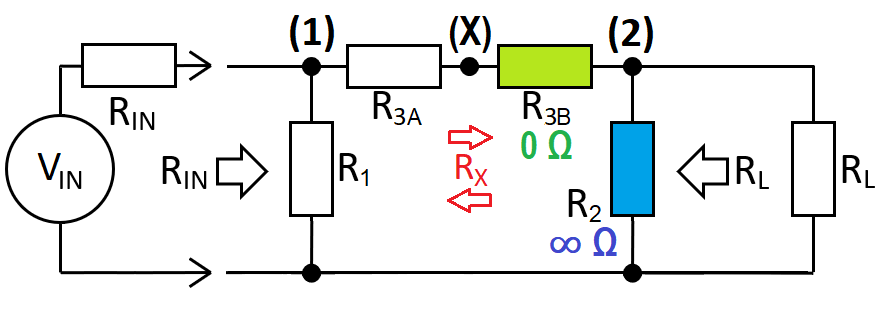
(1) R2 is infinity
(2) R3B is zero
(3) RX equals RL
So, \(A_{12} = \dfrac{R_L}{R_L+R_{3A}}\)
Using equation (4): -
\(A_{12}= \dfrac{R_L}{R_L+R_L\sqrt{1-\frac{R_{IN}}{{R_L}}}}\)
\(A_{12}= \dfrac{1}{1+\sqrt{1-\frac{R_{IN}}{{R_L}}}}\)
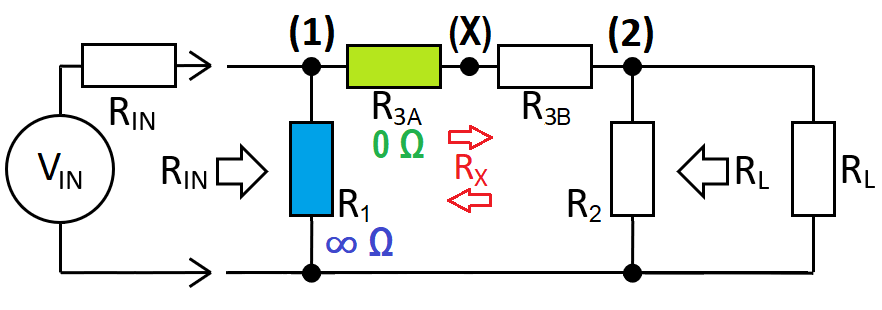
(1) R1 is infinity
(2) R3A is zero
(3) RX = R3B + R2||RL = RIN
So, \(A_{12} = \dfrac{R_2||R_L}{R_2||R_L+R_{3B}}\)
Using equation (5) and point 3 of the notables: -
\(A_{12}= \dfrac{R_{IN}-R_{3B}}{R_{IN}}=\dfrac{R_{IN}-R_{IN}\sqrt{1-\frac{R_L}{R_{IN}}}}{R_{IN}}\)
\(A_{12}= 1-\sqrt{1-\frac{R_L}{R_{IN}}}\)